MONZO AWARE • CASE STUDY
Budgeting, but sexy.
TIMELINE
3 Months
2026
TEAM
1 Designer (me)
SKILLS
UI Design
User Research
Interaction Design
Motion Design
TOOLS USED
Figma
Jitter
Blender
Fusion 360
Project Overview
Monzo is the UK's largest digital bank and one of the few platforms where users spend, save, and budget all in one place. Monzo Aware is a multi-channel solution that builds on that ecosystem to bring budget awareness into the moments where money is actually spent rather than treating it as a separate activity.
PROBLEM
Breaking news: budgeting sucks
With the cost of living crisis straining household budgets, helping people stay on top of their finances matters more than ever. The payments industry has spent years making spending effortless, but budgeting has not received the same treatment. The result is a common experience where money leaves your account instantly but understanding where it went requires deliberate effort, usually after it's too late. For Monzo, there's an opportunity to leverage its tightly integrated ecosystem to solve a problem that's relevant to many, and build consumer loyalty as a result.

Spending is effortless. Budgeting is not.
The shift to contactless payments and Apple Pay has entirely removed the physical friction of spending money. Digital money no longer feels real. Meanwhile, the tools used to manage that money have remained high friction, requiring manual and retroactive tracking. There is a fundamental imbalance in the modern financial experience.

Proactive vs reactive budgeting
Current budgeting tools are reactive. They focus on educating users after they overspend, creating a negative cycle of blind spending, shame, and financial avoidance.
SOLUTION
Target the behaviour before it happens
At its core, Monzo Aware is a strategic design intervention that changes how users interact with their finances by intercepting the act of spending at the point of decision. It leverages existing channels, regulatory changes, and technological innovations to drive behavioural change without compromising on convenience.

CORE FLOWS
Six touchpoints. One cohesive ecosystem.
Rather than designing one feature, Monzo Aware is a connected system of six touchpoints. Each one addresses a different moment in the spending journey, guided by three principles: don't block spending, don't shame the user, and don't rely on them remembering to check.
Monzo Aware Card
A slim card with fingerprint authentication that bypasses the contactless limit. A light touch reveals your remaining category budget before you pay, quick presses cycle between categories or Pots, and a hold authorises the payment.
Onboarding
The onboarding process guides users from discovery to ordering and setup for a seamless introduction to the hardware. The budget tab was redesigned to bring everything into a single colour-coded that mirrors the card’s interface, visually connecting the physical and digital channels. Other optimisations include customisable groups and the ability to edit budgets directly on the page.
Proactive Spending Alerts
The system identifies the store you're walking into and surfaces the relevant budget on your lock screen before you even reach the till.
3D Secure
Real-time budget context built into the existing online payment approval flow, giving users a clear view of their remaining funds before authenticating a transaction.
Subscription Management
A centralised dashboard where users can view all their scheduled payments and easily block future charges.
Goals-Focused Savings
The savings plan calculator helps users commit to realistic long-term goals. The rollover feature flips the logic of round-ups, rewarding users for spending less rather than saving by spending more.
HARDWARE FEATURES
Monzo Aware Card

Budget at a glance
An ultra-low energy e-ink screen surfaces real-time spending limits, transforming a static piece of plastic into a dynamic financial dashboard.
Limit-free contactless payments
Secure on-device authentication bypasses standard contactless caps, allowing you to pay any amount without the need to remember a PIN.
Wireless charging
Built-in magnets precisely align the card to the back of compatible phones for effortless reverse wireless charging.
Biometric authentication
RESEARCH
"I wish my budget was more motivational rather than judgemental"
I analysed consumer market reports, emerging trends, and competitor offerings across neo-banks and budgeting tools to determine whether gaps lay in features or delivery.
To build empathy with users, I conducted ethnographic observation in a retail environment over several weeks. Watching customers at the checkout revealed real-time purchasing behaviours and friction points. I followed this with a targeted user survey to understand the psychological drivers behind budgeting failures.

Primary research
75% of respondents budget but rarely check. 60% are satisfied with their bank's tools. Yet the average self-rated ability to stick to a budget was 4.6/10. People have the tools but can't stick with them.
The ethnographic observation revealed that budgeting tools like Pots actively create friction at the point of payment, causing embarrassment, delays and fallback to untracked credit cards.

Secondary research
Third-party apps struggle with disconnected data requiring users to manage their finances in two separate apps.
Monzo's ecosystem holds a distinct advantage. Because users budget on the same layer where their money lives.
EXPERIENCE MAPPING
Synthesising research into direction

Finding patterns
All research findings were grouped into an affinity diagram, revealing five recurring themes that each went on to directly inform a touchpoint.

Building empathy
Research data was distilled into two personas representing distinct spending behaviours, each with a current-state journey map highlighting where budget awareness breaks down.
DESIGN STRATEGY
A connected system, not a single feature
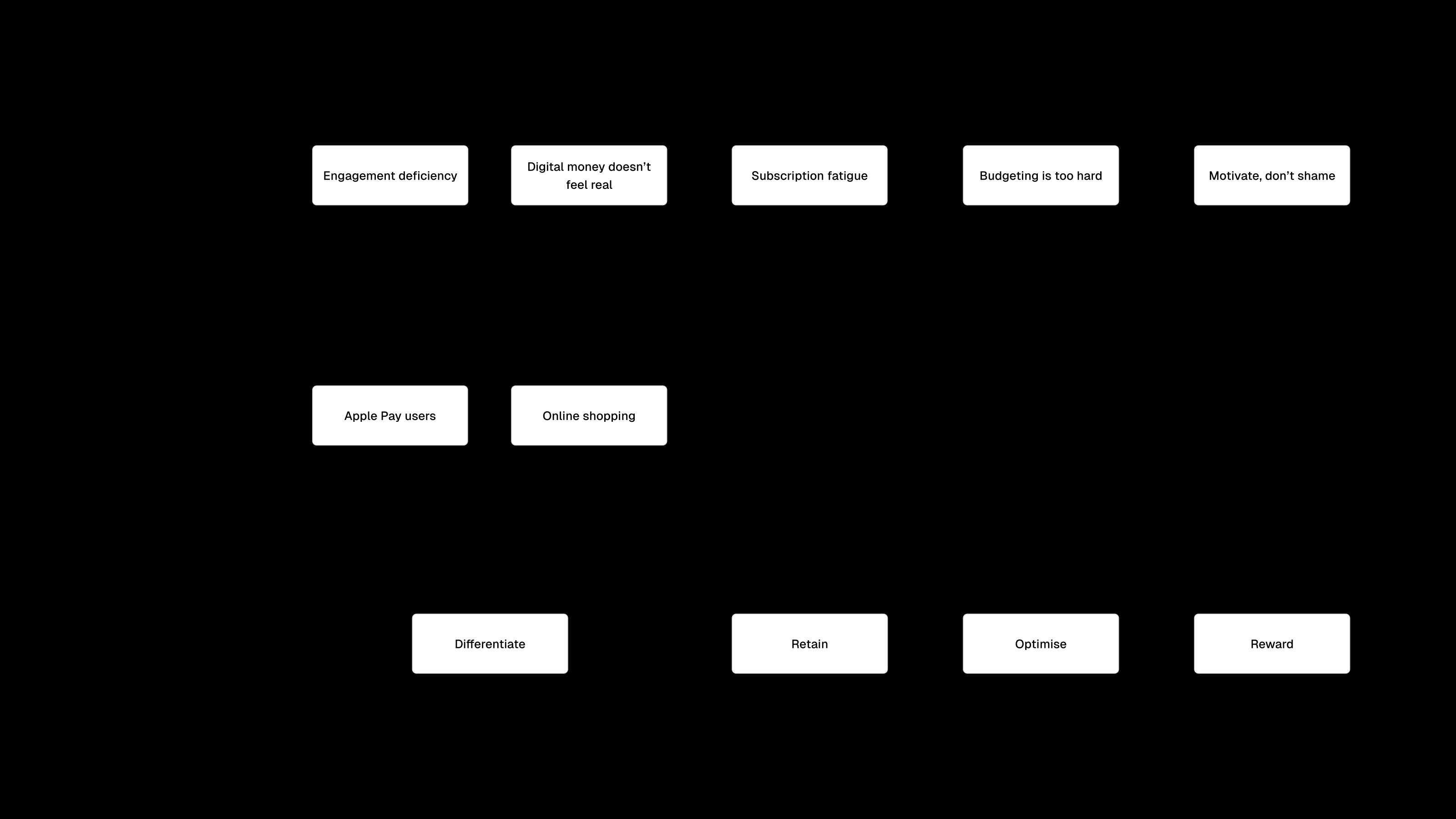
The solution required more than a redesign. A system was built to cover every surface where money moves: the card and Live Activity for in-person spending, 3D Secure for online checkout, Subscriptions for invisible spending, the Budget page and Savings for planning and reward. Mapping these relationships first kept every later decision consistent.
PRODUCT Viability
Structuring a resilient service model for lasting impact
Sustainability
To minimise the card’s environmental impact, material durability matches the battery's lifespan, supported by energy-efficient components and a dedicated card refurbishment pipeline.
Business model
Bundling the card into the existing Monzo Max subscription with a six-month minimum term offsets hardware costs while driving long-term habit formation.
SERVICE MAPPING
Mapping invisible system calls
The service blueprint maps a complete in-store payment scenario through the Proactive Spending Alerts flow, tracing every interaction across the different layers that make the service possible. It shows how the user's experience connects to the systems and processes running behind it, with other touchpoints appearing where they naturally intersect. Its purpose was to test whether separate touchpoints could function as one connected service.

USER INTERFACE
Reverse-engineering an established visual language
Instead of standard wireframing, I reconstructed Monzo’s design architecture from scratch, matching both visual rhythm and conversational tone to ensure every new addition felt native and cohesive.

Design system
Reverse-engineered Monzo's visual language into a strict 4-point grid system, establishing a consistent visual rhythm across margins, typography, and iconography that feels natively integrated.

Scalable component library
The component library is extensive, featuring button states, custom iconography, variable buttons and more. Content blocks were built using nested auto-layout frames and a 4-point grid system for responsive scaling across different screen sizes.
DIGITAL PROTOTYPE
Software and hardware as one seamless experience
I designed over 80 pages across the 5 digital touchpoints iterating based on user feedback while working across touchpoints in parallel, so improvements in one naturally carried over to the others. The onboarding prototype was a result of this iteration, combining automated timers with manual inputs to simulated the setup process.

PHYSICAL PROTOTYPE
Hardware constraints and ergonomics
The hardware design was an exercise in reduction. Early sketches of a wallet were scrapped due to durability concerns. Instead, the final solution was condensed into a 3mm card with a stainless steel frame for structural integrity. I conducted user testing with ten participants to study natural thumb placement during point-of-sale interactions, ensuring the physical interaction felt intuitive and natural.

Inclusive Design & Testing
Designing with empathy and evidence

Accessibility
Relying on colour alone excludes colour-blind users, so I recalibrated the palette to maximise contrast and added custom colour filter controls, plus a separate slider to adjust text and icon sizes. To maintain clarity at larger scales, the card's responsive layout dynamically displays fewer bars to prevent overlapping.

User testing
A user identified a duplicated Pot selection step where the same choice appeared on both the savings dashboard and the following page. Testing with three users confirmed the choice belonged on the dashboard, so the redundant step was removed.
REFLECTION
What I learned
Designing for psychological safety
Early on, I tried to simplify the interface by merging Pots and Categories, but user testing quickly proved me wrong. Users rely on Pots not solely as a method of categorisation, but as a form of reassurance. I learned that good design is not just about reducing complexity. It is about respecting how people actually think and feel, and recognising that emotional comfort is sometimes more important than strict optimisation.
Systems thinking in practice
This project taught me that product design is rarely confined to a single screen. Bulding a genuinely cohesive experience meant ensuring that a hardware button, a lock screen notification, and a backend matching algorithm all spoke the exact same language.